David Norris
QOI Rotation, Fall 2005
Rolston Lab
Diode Laser Locking with Stabilized Fabry-Perot Cavity
Motivation
A future experiment is planned to demonstrate the Rydberg blockade effect, in which an atom raised to a high energy level inhibits the excitation of neighboring atoms by virtue of its large electric dipole moment. Such a mechanism could be used as a quantum logic gate.
The experiment calls for 480.00 nm light to excite cooled rubidium atoms from the 5p3/2 state to the 50s1/2 state. Such a high-frequency commercial laser is not readily available. However, we can attain this frequency by sending the beam from a 960 nm diode laser through a doubling cavity.
Three factors determine the wavelength of a diode laser: the temperature of the cavity, the injection current into the diode, and the angle of the grating through which the beam passes. Fluctuations in temperature, electrical noise, and mechanical vibrations then all serve to change the frequency. Our goal is to stabilize the wavelength of this infrared diode laser in order to access the tightly-spaced Rydberg levels in rubidium.
Procedure
The most common method for stabilizing a laser is to compare its frequency with some constant spectroscopic feature, such as an absorption peak in an atomic spectrum (Fig. 1, left.) The derivative of such a shape (Fig. 1, right) gives an error signal that provides electronic feedback to keep the laser frequency locked to the reference frequency.
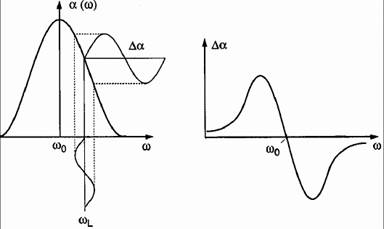
Figure 1
Because there is no convenient atomic transition for locking our 960 nm diode laser, we employ instead the spectrum from a Fabry-Perot cavity. The Fabry-Perot is a mirrored cylinder of length L from which only light of half-integer wavelength (L = nλ/2) can escape. Its spectrum has sharp fringes at these frequencies, ideal for generating an error signal.
Unfortunately, the cavity is subject to the same thermal and mechanical noise as the laser, meaning its length L is not constant. We resolve this problem by locking the cavity to an external marker that is stable, namely the 852 nm transition in cesium. An electric stepper motor attached to one mirror keeps the length constant by ensuring that the cavity is on resonance with a laser beam already locked to the transition. The wavelength of the reference beam can then be adjusted so that the length L is a half-integer multiple of both this wavelength and 960 nm.
Since we cannot determine the exact frequency from the Fabry-Perot cavity (because we cannot accurately measure L), we instead use a wavemeter. This device uses laser interferometry to measure the wavelength to eight significant digits. By this process, we can guarantee that our light is precisely 960 nm in wavelength and stabilized by the cesium transition.
My
Contribution
- Aligned 852 nm and 960 nm beams through the Fabry-Perot cavity
- Generated error signal in both beams
- Soldered connections for electronics
- Coupled 960 nm light to optical fiber for transport to wavemeter
- Measured mode-hope-free range of diode laser
Results
An important characteristic of a diode laser is its mode-hop-free frequency range: the amount by which its wavelength can be changed before interference from another longitudinal mode begins. Slowly adjusting the grating voltage and measuring with the wavemeter, I found a maximum range of .116 cm-1, or about 3.5 GHz. In addition, the frequency changes at a rate of .0038 cm-1/V.
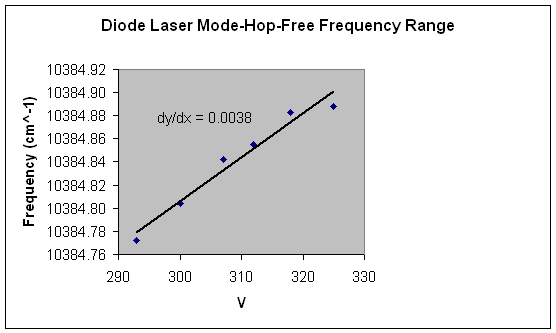
Though these measurements were made around 10384 cm-1, or about 963 nm, the actual experiment requires 960 nm. As no combination of injection current, temperature, or voltage can change the frequency by such a large amount, the grating will require manual adjustment.
Remaining Work
The 852 nm laser is locked to the cesium transition, and the locking electronics for the Fabry-Perot cavity are almost complete. The next step is to assemble all parts for locking the 960 nm beam to the cavity. With this complete, the 480 nm light will be ready for use in the Rydberg blockade experiment.