| Physics 161-020x |
Second Hour Exam (Solutions) |
| April 5, 2004 |
Instructions: Answer the questions both on these exam pages and on the "Scantron" sheet. You will hand in both, therefore fill in your name above AND, last name first, on the Scantron sheet (Your Student Number is not required). Also fill in the pledge on the reverse side of the scantron sheet.
Possibly useful formulas: Always use g = 9.8 m/s²
|
vf2 = vi2 + 2a(xf - xi) ar = |
v2
r
|
|
|
|
|
å
i
|
Fi = ma ffriction = mN Fgravity = mg |
|
|
W = F·d |
å
| W = Kf - Ki K = 1/2 m v2 Ug = mgy |
|
Geometry:

I. CarTalk recently reported about a motorist who had loaded several sheets of plywood on the flat roof of his car and, because they were not tied down, was driving very carefully, where there was no traffic -- except one car that cut him off. He slammed on the brakes, plywood came down on his hood, tore off headlight and bumper ... which gave him pause to do the a calculation in dynamics:
- The coefficient of static friction between plywood and car was ascertained by finding the maximum slope of some part of the car where a small piece of plywood can remain without slipping down. What must have been this slope (rise/run) if the coefficient of static friction µ calculated from it turned out to be 0.4?
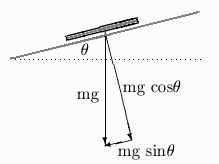 The required slope is given by tanq. From the figure, the normal force is N = mg cosq, the tangential force (balanced by friction) is mg sinq = µN = µmg cosq. Solve for
| tanq =
| sinq
cosq | = µ = 0.4 |
On scantron 1: Mark first digit after decimal of the slope. -- that would be 4
- From this coefficient of friction, calculate the maxiumum deceleration, in m/s², that is possible without the sheets of plywood slipping.
When the sheets are resting horizontally on the car, the normal force is mg. hence the maximum frictional force is µmg, and the maximum acceleration is a = (this force)/m = µg = 0.4 × 9.8 m/s² = 3.92 m/s².
On scantron 2: mark integral part of answer (integer before decimal) -- namely 3
- The car was traveling quite slowly, 7 m/s (about 15 mph), before the point where it had to slow down. How far would it have traveled at the maximum deceleration you found in (b) before it coming to a stop?
Easiest to use first formula from collection above (or conservtion of energy, which is that formula × m/2),
vf2 = vi2 + 2a(xf - xi). Here vi2 = 7 m/s, vf2 = 0, a = -3.92 m/s², sodistance = xf - xi = 7²/(2×3.92) = 6.25 m
On scantron 3: mark integral part of answer -- clearly 6 = 1 (mod 5)
On scantron 4: mark units of answer -- m of course
- Suppose the car had tried to avoid the one obstacle not by braking but by swerving at constant speed, so it describes a part of a circle of radius r. What is the smallest r it can use without losing the plywood?
Here the acceleration is v²/r = µg (as in part b) so r = v²/µg = 49/3.92 = 12.5 m
On scantron 5: mark integral part of answer -- that's 12 = 2 (mod 5)
II. Speaking of braking, here is a way to compute the braking distance D for a car of mass m moving initially with speed v from two principles,
- the maximum decelerating force Fmax can be computed from the coefficient of static friction, µ, between the tire's rubber and the road
- the work done by the decelerating force must equal (in magnitude) the car's initial kinetic energy.
Write two equation expressing these principles, and solve for the braking distance D in terms of v, µ and g (the acceleration of gravity).
Fmax = µmg Fmax D = 1/2mv2 therefore
On scantron 6-10 mark the answer in the form
| D = |
(6)(7)
(8) (9) (10) | where 6, 9 and 10 are letters, and 7 and 8 are numbers. |
So you read off, for example: scantron 7 is 2, scantron 9 is µ = c etc. Note I had to represent µ and g by the same letter (c) because you might have written gµ. In future exams I will ask that you put all products in alphabetical order (gµ in this case), eliminating such ambiguity.
III. A window sash of height 1 m and weight 50 N is normally supported by two equal weights that are just large enough to let the window stay in any open or closed position. However, one of the ropes between window and weight has detached (figure A). The rope on the right was somehow reattached and we do not know whether the window was left open (as in figure B) or closed when finished. Nevertheless, if the system is frictionless, we can find the net work W done during the repair on the window + weights system. Do that, show your work: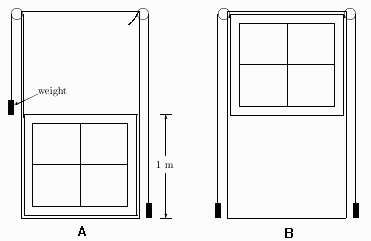
For balance, either weight must weigh 25 N. The easiest way is then to pull down the string on the right to where it should be attached to the window. This raises the right weight by 1 m, and the work done is 25N × 1 m = 25 J. Alternatively we could raise the window so it meets the string. In that case we raise 50 N and the left weight of 25 N is lowered, both by 1 m, so the work done is again 25 J
Mark the answer for W on scantron 11. -- Here 25 = 5 (mod 5)
12. The reason why the answer is independent of the window's final position is:
- Symmetry
- Conservation of energy
- All forces were conservative
- The system has the same total energy for any position of the sash
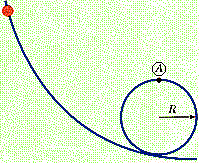 IV. If a car starts sufficiently high on the appropach to a frictionless loop-the-loop track of radius R, it will remain on the track at the top of the loop.
- At the minimum speed, the centripetal force at the top (A) is supplied entirely by gravity (no additional normal force from the track needed). Write that condition and solve for the speed. Also find the kinetic energy K of the car at that point.
|
|
mv2
R
|
= mg v = |
| __
ÖRg
|
K = 1/2mv2 = Rmg/2 |
|
On scantron 13-16 mark your answer for K in the form (13)×(14)×(15) /(16) where 13, 14 and 15 are letters and 16 is a number.
- How much higher than the top of the loop does the car have to start from rest to just make it through the loop without leaving the track? Express your answer in the form (factor) × R.
If the car starts at height h above A, then the change in its potential energy, by the time it gets to A, is mgh. This is converted into the kinetic energy K, so we have
mgh = K = Rmg/2 therefore h = R/2 = 0.5 R.
On Scantron 17 mark the (factor) by its first digit after the decimal point -- The factor is 0.5, the digit is 5.
V. A pendulum is made by letting a 2.0-kg object swing at the end of a string that has a length of 1.5 m. The maximum angle the string makes with the vertical as the pendulum swings is 60°.
|
18 What is the speed of the object at the lowest point in its trajectory?
- 1.98 m/s.
- 2.73 m/s.
- 3.23 m/s.
- 3.83 m/s (see Example 8.3).
- 3.97 m/s.
| |
19 What is the tension in the string at the lowest point?
- 11 N.
- 25 N.
- 39 N (see Fig 8.3 and Eq (3) on that page. Only 20% of you got this answer, the same fraction as by random guessing).
- 42 N.
- 18 N.
|
|
20. For a force to be a conservative force, when applied to a single test body
- it must have the same value at all points in space.
- it must have the same direction at all points in space.
- it must be parallel to a displacement in any direction.
- equal work must be done in equal displacements.
- no work must be done for motion in closed paths. See p. 228