Phys121-040* -- Homework 1
Due Thursday, September 9. For easy reference, the part 1 problems are numbered consecutively, starting with homework0.
In problem 3 please "show your work", that is, explain your reasoning briefly, don't just give a numerical answer.
Also in problem 3, the first time interval is denoted by Dt, and the second by (delta)t, where the Greek capital delta should
look like a triangle. If you use a recent netscape browser, both will probably look like Dt. The easiest way to avoid this problem in future assignments is to use another browser, e.g. explorer.
Problems 4 and 5, except for 5d, may be answered with single letters.
You may answer on a printout of this page (saving you the careful sketch of problem 5).
3. Testing the motion detector
The motion detector we used in our labs, tutorials, and ILDs measures distance to the nearest object by using a speaker and a microphone. The speaker clickes 30 times a second. The microphone detects the sound bouncing back from the nearest object in front of it. The computer calculates the time delay between the making of the sound and receiving the echo. It knows the speed of sound (about 343 m/s at room temperature) and from that, it can calculate the distance to the object from the time delay.
- If the nearest object in front of the detector is too far away, the echo will not get back before a second click is emitted. Once that happens, the computer has no way of knowing that the echo isn't an echo from the second click and the detector doesn't give correct results anymore. How far away does the object have to be before that happens?
- The speed of sound changes a little bit with temperature. Let's try to get an idea of how important this is. At room temperature (72 ºF) the speed of sound is about 343 m/s. At 62 ºF it is about 1% smaller. Suppose we are measuring an object that is really 1.5 meters away at 72 ºF. What is the time delay Dt that the computer detects before the echo returns? Now suppose the temperature is 62 ºF. If the computer detects a time delay of Dt but (because it doesn't know the temperature) calculates the distance using the speed of sound appropriate for 72 º, how far away would the computer report the object is?
|
 |
4. Cars speeding up and slowing down
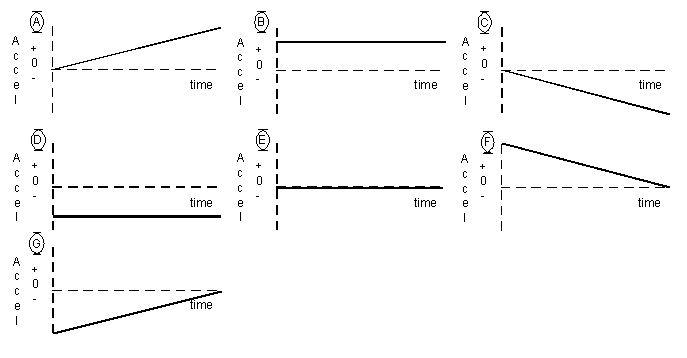
A toy car is moving along a straight track. Its motion is restricted to the + distance axis. For the situations described below, choose the letter of any correct acceleration vs. time graphs that could correspond to the motion described. If you think that none is correct, answer N. You may use a graph more than once.
- The car speeds up at a steady rate, moving away from the origin.
- The car slows down at a steady rate, moving away from the origin.
- The car moves at a constant speed toward the origin.
- The car speeds up at a steady rate, moving toward the origin.
5. Two balls, passing in the night
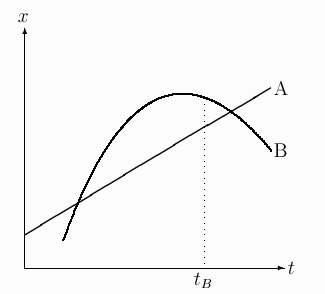
The figure at the right represents the position vs. clock reading of the motion of two balls, A and B, moving on parallel tracks.
Carefully sketch the figure on your homework paper and answer the following questions:
- Mark with the symbol ta along the t-axis any instant or instants at which one ball is passing the other.
- Which ball is moving faster at clock reading tB?
- Mark with the symbol tc along the t-axis any instant or instants at which the balls have the same velocity.
- Over the period of time shown in the diagram, which of the following is true of ball B? Explain your answer.
- It is speeding up all the time.
- It is slowing down all the time.
- It is speeding up part of the time and slowing down part of the time.
|
 |