|
1
|
|
|
2
|
|
|
3
|
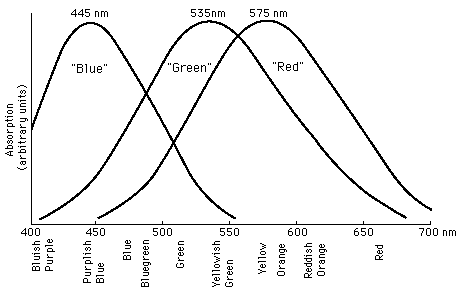
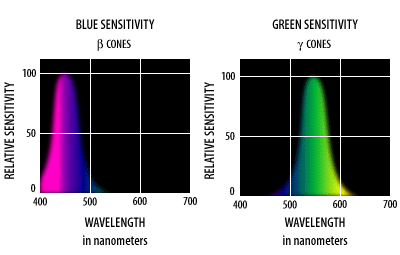
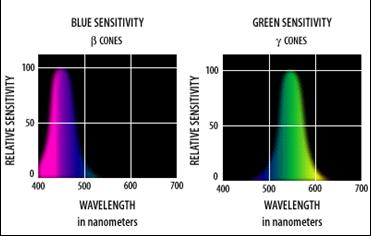
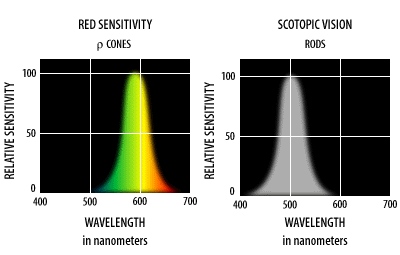
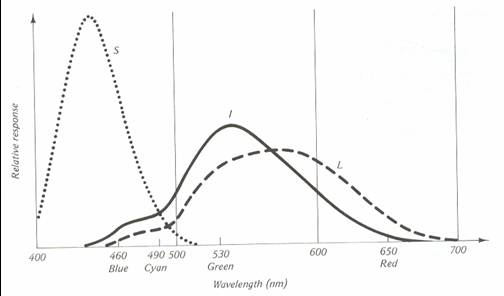
- Because the cones can differentiate colors, there must be more than one
type of cones.
- Thomas Young (1801) postulated three types of cones --- Trichromacy,
based on the three attributes of color: hue, saturation, lightness.
- need three inputs to get three outputs
|
|
4
|
|
|
5
|
|
|
6
|
|
|
7
|
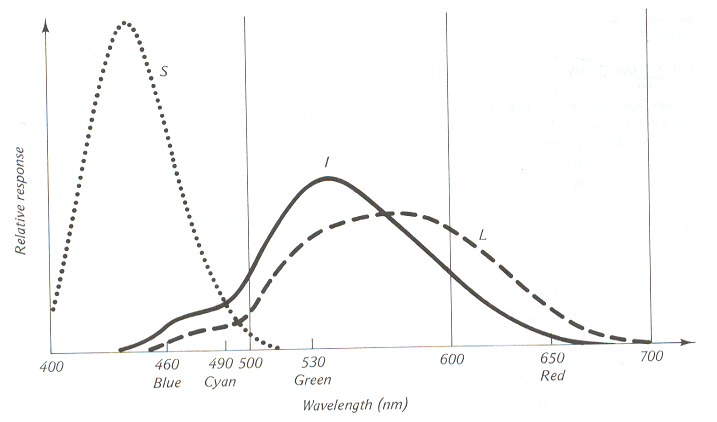
- For white light, all cones respond equally.
- All wavelengths contribute equally to broad-band white light.
- An additive mixture of two complementary lights can also yield white.
- From the region of spectral colors without spectral complementary, we
determine where L & I and S & I responses cross.
|
|
8
|
|
|
9
|
|
|
10
|
|
|
11
|
|
|
12
|
- Consider matching 490-nm spectral cyan which excites the S and I-cones
equally and a little bit of L-cones.
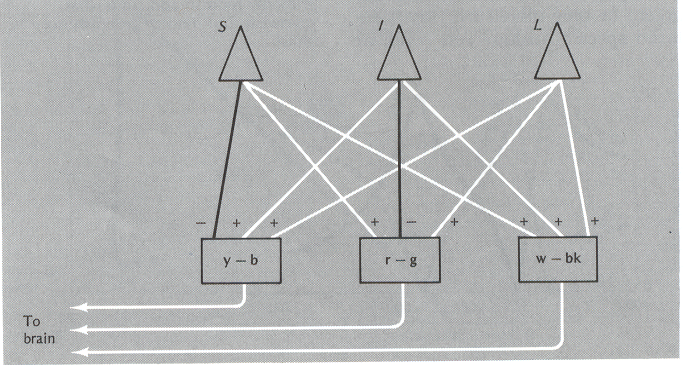
- Use 460-nm blue and 530-nm green and 650-nm red to match cyan. The blue
and green must be roughly the same amount. However, this mixture excite
the L-cones too much, we need anti-red to de-excite the L-cones.
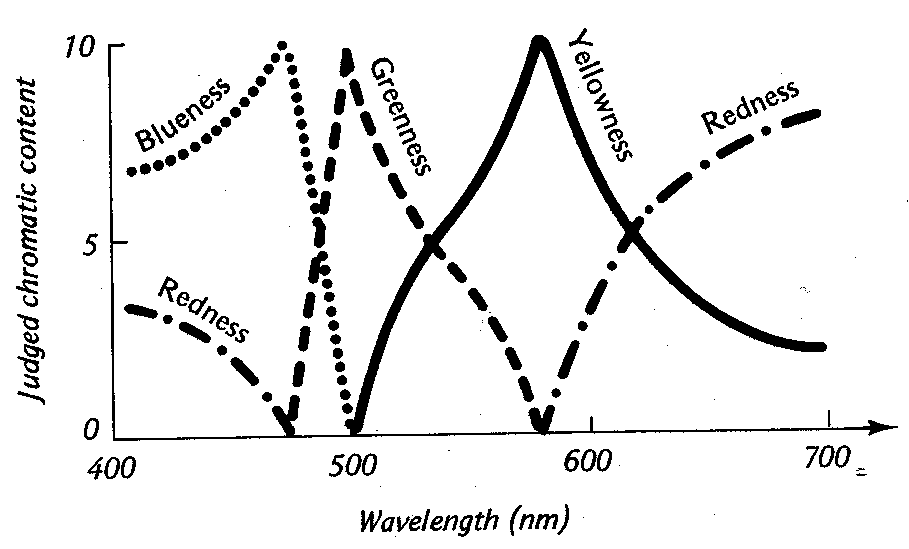
- The information contained in the chromaticity diagram is consistent with
that of the response curves.
|
|
13
|
|
|
14
|
|
|
15
|
|
|
16
|
|
|
17
|
|
|
18
|
|
|
19
|
|
|
20
|
|
|
21
|
|
|
22
|
|
|
23
|
|
|
24
|
|

 Notes
Notes